 Pin it
 My grandmother had a habit of making angel food cake whenever someone needed lifting up—a breakup, a rough week at work, a day that just didn't land right. She'd whip those egg whites in her old yellow bowl, and the kitchen would fill with this quiet magic, the mixer humming while she hummed along. I didn't understand then why she chose something so fussy, so dependent on doing everything just right, but now I get it: there's something about creating something this light and airy that feels like hope in edible form.
I remember the first time I made this alone, my hands shaking a little as I separated those twelve eggs over a small bowl, paranoid that even the tiniest speck of yolk would sabotage everything. It didn't, and something shifted—I realized that precision doesn't have to feel stressful, that following the steps carefully can actually be meditative. When I inverted that pan and watched the cake slide out onto the cooling rack, still steaming slightly, I knew I'd found something I'd make again and again.
Ingredients
- Cake flour (1 cup, sifted): This is non-negotiable—it has less protein than all-purpose flour, which means your cake stays tender and airy instead of turning into rubber.
- Granulated sugar (1½ cups, divided): Split between the dry ingredients and beaten into the egg whites, it dissolves completely and never feels grainy.
- Fine salt (¼ teaspoon): A whisper of salt that makes everything taste more like itself.
- Egg whites (12 large, room temperature): Room temperature is absolutely key—they whip to more volume and stability than cold ones, and any yolk contamination is a dealbreaker.
- Cream of tartar (1½ teaspoons): This stabilizes the egg whites so they don't deflate and gives you those glossy, stiff peaks that hold their shape.
- Pure vanilla extract (1 teaspoon): The backbone of flavor—don't skimp on quality here.
- Almond extract (½ teaspoon, optional): A secret whisper that adds depth without announcing itself.
Tired of Takeout? 🥡
Get 10 meals you can make faster than delivery arrives. Seriously.
One email. No spam. Unsubscribe anytime.
Instructions
- Set yourself up for success:
- Preheat your oven to 350°F and make absolutely certain your tube pan is clean and bone dry—any grease or moisture will keep the cake from rising properly. This is your foundation.
- Create your flour base:
- Sift together your cake flour, ¾ cup of sugar, and salt, then sift the whole mixture two more times. Yes, three times total—this aerates the flour and distributes everything evenly so you get that impossibly light crumb.
- Begin with the egg whites:
- In a large bowl, start beating your room-temperature egg whites on medium-high speed until they're foamy and doubled in volume. This should take a couple of minutes, and it's the moment where everything begins transforming.
- Build the meringue:
- Add your cream of tartar and keep beating until you see soft peaks forming—when you lift the beaters, the peaks gently fold over. Then gradually add the remaining ¾ cup sugar, a tablespoon at a time, while the mixer keeps running. This patience pays off in stiff, glossy peaks that shine like silk.
- Season and fold:
- Once you have those peaks, add your vanilla and almond extracts and fold gently with a spatula—just a few turns. This meringue is delicate, and you're protecting every bit of air you've worked to create.
- Bring it together:
- Sift your flour mixture over the egg whites in three separate additions, folding gently with a spatula after each one, just until you can't see any white streaks. Folding is about patience—use a motion that cuts down the center, along the bottom, and back up the side, turning the bowl as you go. Overmixing will deflate everything.
- Into the pan:
- Spoon the batter into your ungreased tube pan, smoothing the top gently with a spatula. Then take a thin knife and run it through the batter in figure-eights to break up any large air pockets that might create tunnels.
- Bake and trust:
- Bake for 35 to 40 minutes, until the top is golden and the cake springs back immediately when you touch it lightly. The scent will be ethereal and faintly sweet.
- The crucial inversion:
- This is the part that feels counterintuitive: the moment it comes out of the oven, immediately invert the pan onto a bottle, a cooling rack, or even a sturdy glass. The cake needs to cool completely upside down (about 1 to 2 hours) so it doesn't collapse on itself.
- Release and serve:
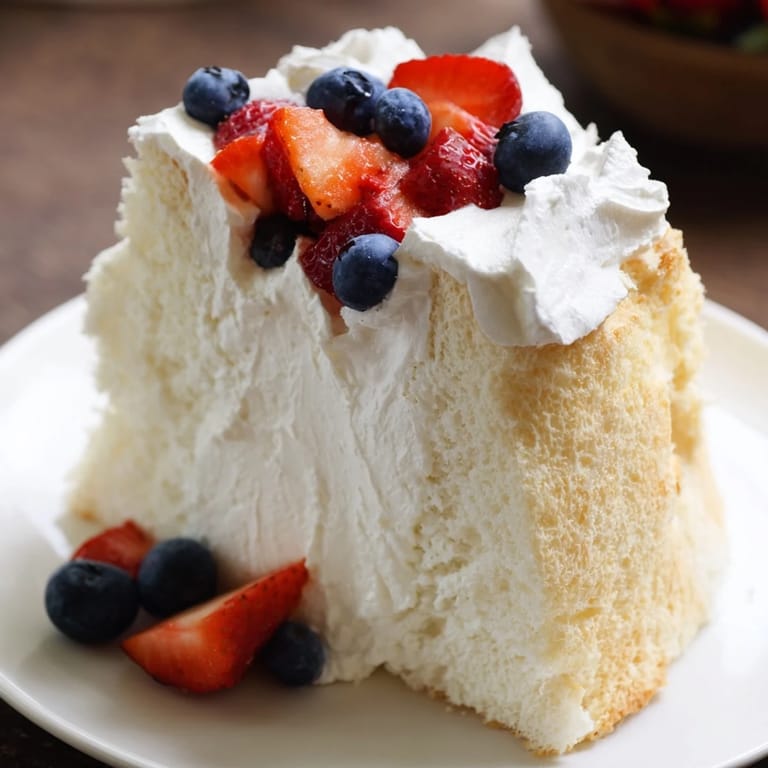
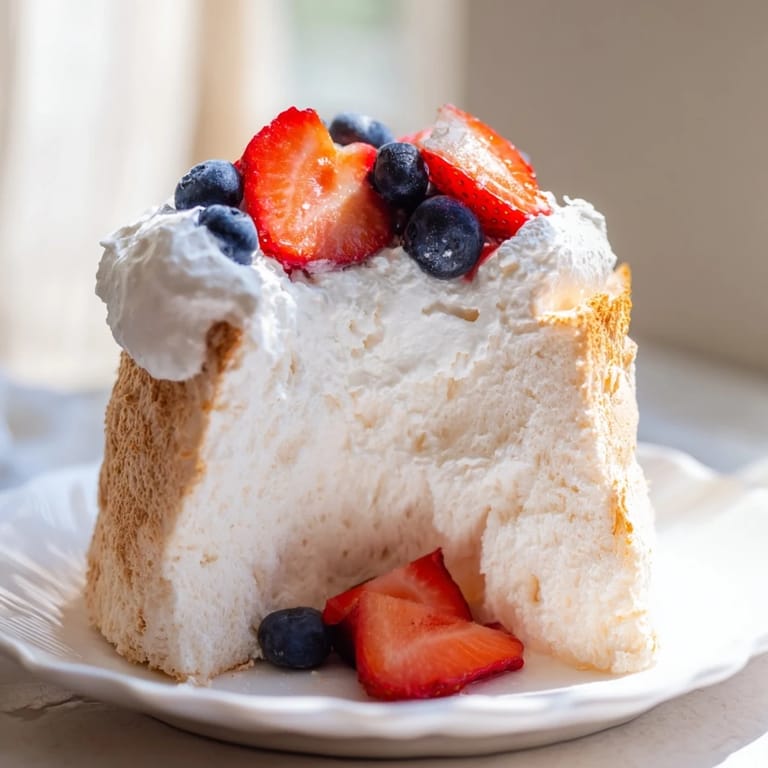
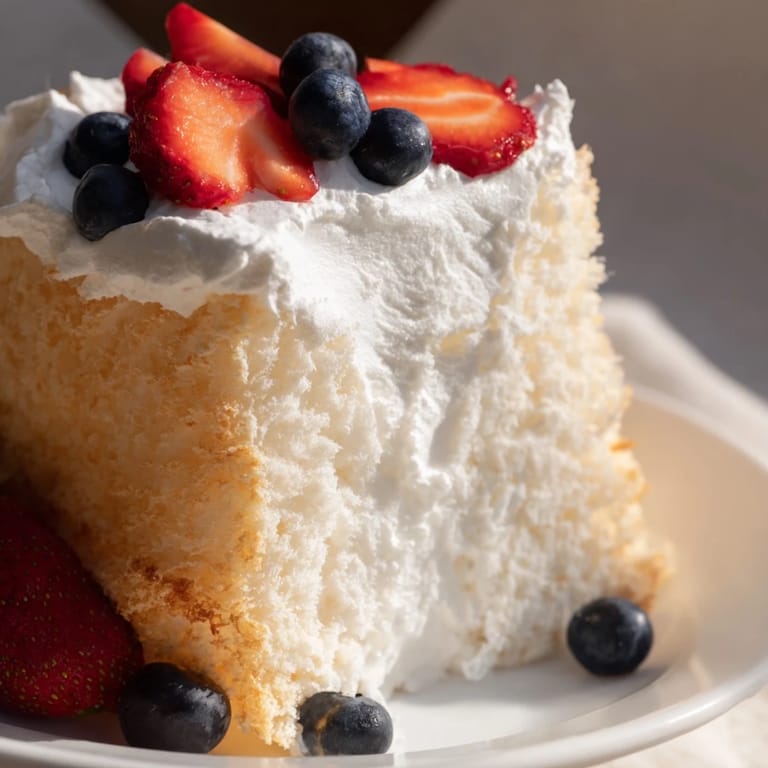
- Once completely cool, run a thin knife around the outer edge and the center tube to loosen the cake, then turn it right-side up and slide it onto a plate. Serve plain, or crown it with fresh berries and a cloud of whipped cream.
 Pin it
 I've served this cake at dinners where conversation had gone quiet, and I've watched it bring people back to the table, to laughter, to being present. There's something about something this light and this deliberately made that reminds everyone that the small rituals—the careful folding, the patience—are what transform ordinary ingredients into something that matters.
Why This Cake Endures
Angel food cake doesn't rely on butter or oil to seduce you—it's all about structure, timing, and respect for what egg whites can become when you treat them right. It tastes like possibility, like something you thought impossible becoming real the moment you taste it. It's a cake that rewards precision without demanding perfection, and that's rare.
Variations and Flavor Twists
I've tried lemon zest stirred into the egg whites, which brings brightness without changing the texture. I've folded in a teaspoon of instant espresso powder for a subtle, sophisticated depth. Some seasons I dust the finished cake with powdered sugar, others I let fresh raspberries and their juice be the only sweetness. Each variation teaches you something new about how delicate this cake really is, how a tiny change echoes through the entire thing.
Serving Suggestions and Pairings
This cake is a canvas, not a statement—it exists to complement rather than dominate. Fresh berries are the obvious choice, their tartness playing against the cake's sweetness like a conversation. A light sparkling wine works beautifully, as does a fruit coulis made from whatever berries are at their peak. Even on its own, with a cup of tea, it feels like an event.
- Pile on macerated strawberries or fresh raspberries while the cake is still slightly warm so the juices soak in.
- A dollop of whipped cream beaten with a touch of honey and vanilla is all the embellishment some moments need.
- Leftover cake (if there is any) stays fresh for three days wrapped loosely, and is somehow even better on day two.
 Pin it
 This cake has taught me that sometimes the simplest things—eggs, flour, sugar—become extraordinary through care and intention. Making it reminds me why I love to cook.
Frequently Asked Questions
- → What makes this cake so light and airy?
The cake's lightness results from whipped egg whites folded gently with sifted cake flour, creating a delicate, airy texture.
- → Why is the pan left ungreased during baking?
Leaving the pan ungreased allows the batter to cling to the sides and rise properly, ensuring the characteristic fluffy structure.
- → Can almond extract be omitted or substituted?
Yes, almond extract is optional and can be omitted or replaced with additional vanilla extract for a different flavor nuance.
- → How should I cool the cake after baking?
Invert the pan onto a bottle or wire rack immediately to cool completely upside down, preserving its volume and preventing collapse.
- → What are good serving suggestions for this cake?
Serve with fresh berries and whipped cream or accompany it with a fruity coulis or light sparkling wine for enhanced enjoyment.